Tag Archive for 'Microsoft Word Course'

Microsoft Word Tips – How to Copy Formatting Quickly

Let’s say you’ve just applied various formatting options to text, for example you might have selected bold, italic, underline; changed font and size of font; applied a different colour, added borders and shading, and even adjusted different line spacing. Now you would like to quickly reproduce this formatting in several places in your document.


You can save time by copying the format you’ve already applied to text using Format Painter. To do so follow these steps:


  1. Select the text that has the formatting that you want to duplicate.Microsoft Word Format Painter
  2. On the ribbon from Home tab, in Clipboard, click the Format Painter button. When you move from the Ribbon back to the document, the mouse pointer now appears as I-beam with a paint brush.
  3. Select the text you want to reformat by dragging the mouse to highlight the text.
  4. As soon as you release the mouse button, the text receives the format of the other text. The feature is turned off and the mouse pointer returns to the original default pointer.


If you have several pieces of the text throughout the document that you want to reformat, then follow steps 1 to 3, however in step 2, double click the Format Painter button and select text to format those pieces of text. When you’re finished, click the Format Painter button to turn it off.


Want more tips? Click on Microsoft Word Tips & Tricks

Microsoft Office Tips – How to Fix Errors Using Microsoft Office Diagnostics

Microsoft Office 2007 DiagnosticsIn Why to Use Microsoft Office Diagnostics we discussed the benefits and diagnostics options available. Here we are going to discuss how to use the diagnostics.


Before you start the diagnostics:

  • Run the diagnostics when you do not need to use your computer
  • Make sure you are connected to the Internet
  • Close other programmes
  • Make sure you have Microsoft Office installation disk in case there are problems and your program will need an access to the disk to repair


If Microsoft Word, Excel, PowerPoint or Access are still working then to start the Microsoft Office Diagnostics follow the steps:

  1. Click the Microsoft Office Button Microsoft Office Button, and then click Word Options (or Excel Options or PowerPoint Options or Access Options)
  2. Click Resources
  3. Click the Diagnose button
  4. Click Continue, and then click Run Diagnostics.


If InfoPath, OneNote, Outlook, Publisher, Project, SharePoint Designer, or Visio are still working then to start the Microsoft Office Diagnostics follow the steps

  1. On the Help menu, click Office Diagnostics.
  2. Click Continue, and then click Start Diagnostics.


If any of the above programmes has crashed so badly that they not start, you can run Office Diagnostics from the Start menu.

  1. In Windows, click the Start button
  2. Point to All Programs, then to Microsoft Office and then to Microsoft Office Tools
  3. Select Microsoft Office Diagnostics


To check which tests are available read Tips and Tricks: Microsoft Office 2007 – Why Use Microsoft Office Diagnostics?


Want more tips? Click on Microsoft Tips & Tricks

Microsoft Word Tips – How to Select Text Vertically in Word

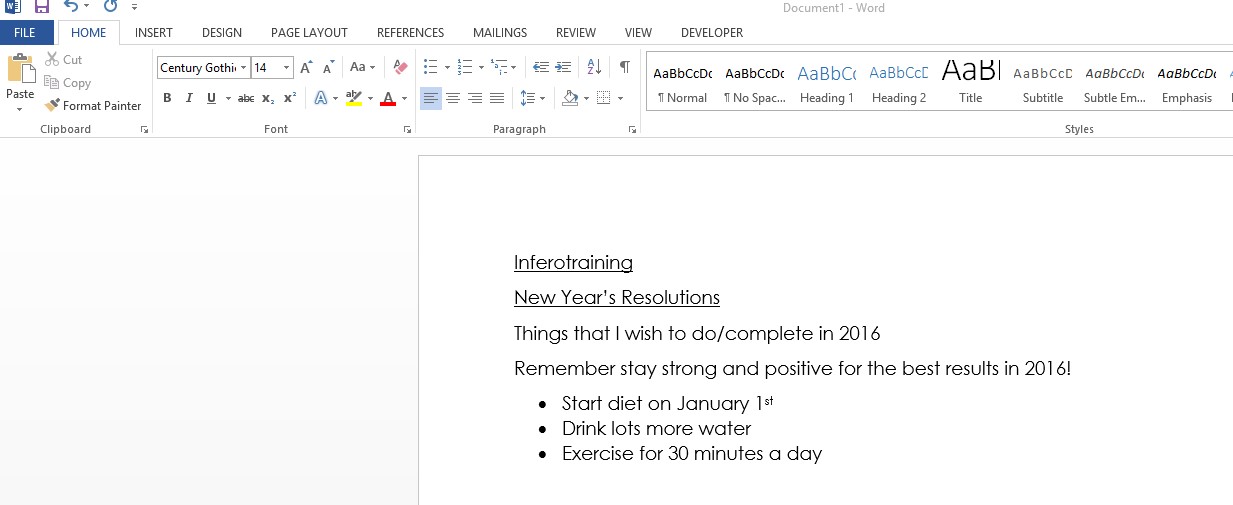
You probably get used to selecting text horizontally from left to right or right to left, for example, to format or copy it. For the left to right selection, click just before the beginning of a word, and while holding the mouse button down, drag to the end of the section that you want to highlight. For the right to left selection doing everything backwards achieves the same result. But what if you want to select a text vertically, for example, to apply some formatting to the first 2 words in the text of each line as on a picture? Here’s a handy tip.


Microsoft Word 2007 Vertical Selection Before


You can select the text vertically. In order to do that, just hold down the <Alt> key on a keyboard whilst you are selecting the text as usually. You will get this result.


Microsoft Word 2007 Vertical Selection Highlighted 


Now you can apply any formatting to it (here we selected Chicago font style).


Microsoft Word 2007 Vertical Selection After Formatting 


Although in the example above we selected text at the beginning of the lines, you can make vertical selections anywhere on the page.


Want more tips? Click on Microsoft Word Tips & Tricks

Microsoft Word Tips – How to Get Rid of the Hyperlinks

Have you ever opened a Word 2007 document using Microsoft Word 2007 and had your hyperlinks display

{ HYPERLINK “http://www.inferotraining.com/info.html” } instead of Info?


You try to make these hyperlinks display properly with correct links. You check different view options and they all work fine. However, you cannot get rid of this display. What can you do?


To solve the hyperlink problem here are a few options:


  • use Alt+F9 to toggle between the Hyperlink display and Normal view.


  • Alternatively,

Microsoft Word 2007 Advanced Options - Hyperlinks

  1. Click on the Office button
  2. At the bottom of the displayed menu, select Word Options
  3. From the Word Options dialog box, on the right hand side, select Advanced
  4. Scroll down until you see Show document content and turn off the Show field codes instead of their values setting


Want more tips? Click on Microsoft Word Tips & Tricks

Tips and Tricks: Microsoft Office 2007 – Why Use Microsoft Office Diagnostics?

You probably get very upset when your Microsoft Office application crashes down (closes down unexpectedly) while you are working on something important. It is not necessarily that the problem is within the Microsoft Office code. Computer viruses (read How to Protect Yourself from Viruses from Your Computer Health Part Two), disk failures, or laziness with respect to installing updates (read How to Stay up to Date Automatically from Your Computer Health Part One) are just a few issues causing this condition.


Microsoft Office Diagnostic is a tool included in Microsoft Office 2007 pack, allowing you to run a series of diagnostic tests that can help you discover why your computer is crashing. These tests will either solve problems directly or may help you with the ways to solve them.


These are the diagnostics that are run:

 Microsoft Office 2007 Diagnostics Options

Setup Diagnostic – Files and registry are checked for errors occurring due to viruses or by hardware that is faulty or incorrectly configured. While running for about 15 minutes, the test may require the original installation source.


Disk Diagnostic – Hard disk is examined for errors logged by the Windows system and SMART (Self-Monitoring, Analysis and Reporting Technology) feature of your hard disk (if provided by disk drive manufacturers) to notice potential hard disk failure.


Memory Diagnostic – Random Access Memory (RAM) is verified for integrity.


Update Diagnostic – Your computer is tested as to whether it has the latest updates installed to make Microsoft Office more stable. You can install updates from Microsoft Office Online.


Compatibility Diagnostic – Different versions of Microsoft Office are checked for conflicts, as two different versions of Office installed on your computer can cause instability.


Check for Known Solutions – The crash report is tested and checked against the database of Microsoft’s crash cases for available solutions.


To find out how to run diagnostics, read How to Fix Errors Using Microsoft Office Diagnostics.

At Home with Microsoft Word Checklists

Microsoft Word 2007 ChecklistMicrosoft Word can’t do the hoovering – or make you a nice cup of tea. But it can put you in more control at home. Word checklists are ideal for helping you manage all kinds of activities in your very own castle. Who would have guessed that some simple Microsoft Word training could give you so much extra organisational oomph?


To do – stop using scraps of paper

Do you have scraps of paper with ‘to do’ tasks scribbled on them? Confusing isn’t it? And bits of paper have an uncanny knack of getting lost just when you need them. Keep it together with a Word activities checklist.


Keep track of the kids

Everyone knows that taking care of little ones requires extreme organisational resources. Even a trip to the local park can feel like an outing for an ‘A’ list celebrity. There are the bags, the toys, the clothes, the demanding dietary requirements….and that’s before you even get to the park! Why not create your own checklist to keep all those child-related chores on track?


Dream a little dream (and make it happen)

You know the saying – “What gets measured gets managed.” Create your very own dream checklist to state your goals and keep tabs on how close you are to them. Whether you’re working hard towards your ideal home or that perfect job, a checklist can help you clarify exactly what you want. And that should get you closer to your goal.


A gift for giving

Every year we know when those important birthdays are due, not to mention Christmas. But most of us still find ourselves rushing around the shops at the last minute to find the perfect present. How much would a present shopping checklist reduce your stress levels? You could even build in your time and budget for when the sales are on and grab the perfect present and a bargain at the same time!


Something for the book lovers

Still wondering where that favourite book went? Wish you could keep track of all the books you’d like to read in the future? Once you’ve got the knack by taking one of our Microsoft Word courses, you can create your very own Word checklist to keep track of your fiction, your non fiction and that new biography you’ve been wanting to read for ages….


There are so many other ways you can put Word checklists to good use. From preparing for big life changes like having a baby, to everyday essentials like keeping track of your bills. And all that gives you more time for a sit down and a nice cup of tea…

Hints & Tips: Microsoft Word – Show or Hide Formatting Marks

Sometimes you may struggle with formatting and you do not understand why some text is deleted or a page break is entered in the wrong place. In order to help to rectify the problem you may want to display Formatting Marks. Select one of the following:


  • Microsoft Word 2007 Paragraph GroupOn the Home tab, in the Paragraph section, click Show/Hide


  • Or from keyboard press a combination of <Ctrl>, <Shift>, <8> keys simultaneously.


This will display tab characters, spaces, paragraph marks, hidden text etc. Clicking again on the Show/Hide icon or a combination of keys will hide the characters.

Hints & Tips: Microsoft Office – How to Minimise the Ribbon

The Ribbon is designed to help you quickly find the commands. Commands are organised in logical groups that are collected together under tabs according to a type of activity.


You cannot delete or replace the Ribbon with the toolbars and menus from the previous versions of Microsoft Office. However, to make more space available on your screen, you can minimise the Ribbon.


  1. From the Quick Access Toolbar, click Customize Quick Access ToolbaMicrosoft Office - Customize Quick Access Toolbar.
  2. Microsoft Office - Minimize the RibbonFrom the drop down list, select Minimize the Ribbon.  


To use the Ribbon while it is minimised, click the tab you want to use, and then click the option or command you want to use. After your request has been performed, the Ribbon reverts to being minimised.

Hints & Tips: MS Word – Converting Text to a Table

Suppose you have some text which you want to convert to a table.


  1. Indicate where you want to divide the text into columns by inserting separator characters (such as commas or tabs or choose your own). To indicate where you want to begin a new row use paragraph marks.
  2. Select the text that you want to convert.
  3. On the Insert tab, click Table, and then choose Convert Text to Table.
  4. Under Separate text at, choose the option for the separator character that you used to separate your text.
  5. Make sure in the Number of columns box, the correct number of columns is displayed. If not, you may be missing a separator character in the text.
  6. Click OK.

Hints & Tips: Microsoft Office – How to Find Commands in Office 2007

You finally installed Office 2007 and guess what? You cannot find commands you are used to in the Menu!


It will certainly take a while to adjust to a new Menu. So what you can do to locate where your favourite Office 2003 commands are in the new Office 2007 interface?


Microsoft developed visual, interactive reference guides to help you quickly learn where things are. You can download and install them on your computer.


The only downside to it is that you have to download these guides for each of the Office 2007 Applications.


If you are not sure if it will help it, try an online demonstration from one of those listed at Microsoft Office Online.


If you are happy to proceed, use the following links to download command reference guides for each of the Office applications:


Word 2003 to Word 2007 interactive command reference guide


Excel 2003 to Excel 2007 interactive command reference guide


PowerPoint 2003 to PowerPoint 2007 interactive command reference guide


Outlook 2003 to Outlook 2007 Interactive Command Reference Guide


Access 2003 to Access 2007 interactive command reference guide